


Ebook Download Demons (Everyman's Library, 182)
From the combination of knowledge and actions, an individual can boost their skill and ability. It will certainly lead them to live and also function far better. This is why, the students, employees, and even employers need to have reading routine for books. Any kind of publication Demons (Everyman's Library, 182) will certainly give particular knowledge to take all benefits. This is exactly what this Demons (Everyman's Library, 182) tells you. It will certainly add even more understanding of you to life as well as work better. Demons (Everyman's Library, 182), Try it as well as verify it.
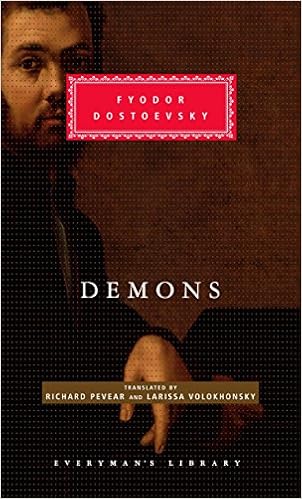
Demons (Everyman's Library, 182)

Ebook Download Demons (Everyman's Library, 182)
Demons (Everyman's Library, 182) Exactly how a straightforward idea by reading can enhance you to be an effective person? Checking out Demons (Everyman's Library, 182) is a very basic task. Yet, just how can many people be so careless to check out? They will certainly favor to spend their leisure time to chatting or hanging around. When as a matter of fact, reviewing Demons (Everyman's Library, 182) will offer you a lot more probabilities to be effective completed with the efforts.
We understand that you are also follower of the writer of this book. So, it will not be even worse for you to choose it as recommendation. Demons (Everyman's Library, 182), as one of the crucial publications to check out can be considered as a book that gives you something suggested. You could take the similar subject from various other book, however the one that could provide you much better perception is this book. This problem will truly affect you to offer the dependable selection.
This Demons (Everyman's Library, 182) is advised for you from every stage of the life. When reviewing ends up being a must, you can consider that it can be part of your life. When you have actually taken into consideration that analysis will certainly be better for your life, you can assume that it is not only a must but additionally a leisure activity. Having hobby for analysis readies. In this manner could help you to always improve your abilities and understanding.
Even we talk about guides Demons (Everyman's Library, 182); you might not locate the published publications below. Numerous collections are supplied in soft data. It will precisely provide you more perks. Why? The initial is that you might not have to lug guide everywhere by fulfilling the bag with this Demons (Everyman's Library, 182) It is for the book is in soft file, so you can wait in gizmo. Then, you could open up the gizmo everywhere and also check out the book correctly. Those are some few benefits that can be got. So, take all advantages of getting this soft documents publication Demons (Everyman's Library, 182) in this website by downloading in web link given.
Review
“[An] admirable new translation of…Dostoevsky’s masterpiece.” –New York Review of Books“The merit in this edition of Demons resides in the technical virtuosity of the translators…They capture the feverishly intense, personal explosions of activity and emotion that manifest themselves in Russian life.” –New York Times Book Review“Demons is the Dostoevsky novel for our age…[Pevear and Volokhonsky] have managed to capture and differentiate the characters’ many voices…They come into their own when faced with Dostoevsky’s wonderfully quirky use of varied speech patterns…A capital job of restoration.” –Los Angeles TimesWith an Introduction by Richard Pevear
Read more
Language Notes
Text: English (translation) Original Language: Russian
Read more
See all Editorial Reviews
Product details
Hardcover: 776 pages
Publisher: Everyman's Library; Reprint edition (October 24, 2000)
Language: English
ISBN-10: 0375411224
ISBN-13: 978-0375411229
Product Dimensions:
5.3 x 1.6 x 8.3 inches
Shipping Weight: 1.7 pounds (View shipping rates and policies)
Average Customer Review:
4.3 out of 5 stars
87 customer reviews
Amazon Best Sellers Rank:
#188,758 in Books (See Top 100 in Books)
A very thought provoking portrait of combating and extreme personalities. As in all Dostoevsky's works, there is a very clear message; it is spelled out by his portrayal of different characters and made convincing by how the reader identifies with and understands both the evil and good present in the characters.I bought the Pevear and Volokhonsky version. The translation itself I thought was better than other Dostoevsky works I've read from other translators (The Brothers K by Garnett and Borders Classic's version of C&P), because I thought that it had fewer awkward and repetitive phrases when describing people. It also had many helpful historical notes lending extra context (needed for the author's then contemporary references). The intro was very helpful as well, giving some interpretive guidance for reading this, as well as other, Dostoevsky works.I've read that some folks find the revolutionary characters in the book unrealistic, a fabrication of the author's mind. However, I would suggest that all who hold this opinion read The Gulag Archipelago by Solzhenitsyn. You will see that his characters are actually quite reasonable compared to the real-life leaders in Stalin's Russia. The P&V version also contains helpful footnotes that point out some events in the book that may seem unbelievable were actually based on real events; including the climax.I think one of my favorite traits about this work is how well explained and logical all the evil ideas seem, but that which is pure and beautiful does not answer this attack with a logical discourse; goodness is beheld in a sort-of silence, a response to truth deeper than a dissertation can express. The main characters always give a convincing why as to their murders and abuses (the real evil characters usually commit wrong from philosophical motives and not from lust), but the one would-be redemptive moment in the book is accompanied by no wordy explanation, only the description of joy and tenderness in the characters participating. Perhaps a hint that the good in humanity is more deeply rooted and hidden than the corruption. This hints at the Orthodox conception of man after the fall, which contrasts with the Calvinistic vision of total depravity that often taints Western thought.
Demons was more difficult to follow than Dostoevsky's other works. There are numerous characters that make minor appearances that come and go in the first half of the novel. Once you get the characters straightened out, the novel becomes engrossing. Dostoevsky is a master of plot structure and characterization. The intricacy and unfolding of the plot are well worth the time it takes to organize who's who. The main character, Stavrogin, presents a mysterious influence over the other characters and throughout the novel. Pyotr Stepanovich is the most relatable to today because of his overt hatred and nihilism. Dostoevsky's prescience and understanding of evil are unparalleled when comparing his stories to the actual history that occurred after his time.His philosophical presentation of the importance of ideas (especially bad ones, "demons") is truly significant and relevant.
Warning--this is the Russian edition of Dostoevsky's master work written in 1871-72. It is a combination political plot revolutionary terrorism and characters who test their rational free will and another who wishes to replace Christ with himself. It is one of Dostoevsky's masterpieces, written after The Idiot and before "The Raw Youth," which was followed by the Brothers Karamazov.
This was the 5th book I have read by Dostoevsky ... it is about revolution and social idealls in 19th century Russia, but it is also about humans and their relationships. I had to keep a character list as I read and had to even sketch a tree of relationships - in the end, a great achievement and highly recommended. (I would not suggest this as your first Dostoevsky read - a better starter would be Crime and Punishment)
When I read previous translations of Demons, the titles always were The Possessed, so in each case the translators obscured the novel's meaning. Now, I think, after reading Richard Pevear and Larissa Volokhonsky's translation, I have been set straight. The demons, in part, are Puskin's goblins and witches, but in a much greater sense they are the lies (rationalism, materialism, anarchism, nihilism, atheism) that enter a man and woman's soul, and like the demons that came out of the man and entered the swine in Luke's Gospel, they drive the man or woman to destruction. Dostoyevsky connects the liberal idealists and freethinkers of 1840's Russia (they are the fathers and mothers) with the Nihilist Revolutionaries of the 1860's. He predicted the Bolshevik Revolution forty years before it happened, because he understood the essence of the revolutionary movement was not social Christianity but Nihilist destruction, from "unlimited freedom it would turn into unlimited despotism." Nikolai Stavrogin stands at the center of the novel, a sensualist, both good and evil, but more evil than good, because evil gives more pleasure. His demon is the thrill some find in danger, sadism, and moral depravity. Stavrogin is strikingly handsome and a taciturn aristocrat, so he is not without glamor. He is mentor to Ivan Shatov, a reformed Nihilist revolutionary, to Pyotr Verkhovensky, the Nihilist revolutionary leader, and to Kirillov, the man-godhead. The novel begins with Stepan Trofimovich Verkhovensky's story, he a liberal of the `40's who continues his rant under the sponsorship of Varvara Petrovna, Stravogin's mother, in a Russian provincial town, where Pyotr Verkhovensky, Stepan Trofimovich's abandoned son, decides to test his Nihilist theories. I never paid much attention to Stepan Trofimovich's story before, but I did this time, as I did to the point of view of the novel's narrator-chronicler, a settler in the provincial town. I read the novel as a coherent whole, not a shipshod piece like before. Memorable female characters include Marya Ignatievna, a cripple half-wit, married to Stravogin on a whim, Lizaveta Nikolaevna Tushin, infatuated with Stavrogin, and Darya Pavlovna (Dasha) Shatov, devoted to Stavrogin. The Foreward and End Notes to the novel are excellent. Humor comes from such unexpected people as Fedka the Convict, an evil soul Dostoyevsky knew well, having spent ten years in a Siberian prison and in exile for his "revolutionary activities." Demons affected me tremendously. Its intellectual power enveloped me in realization after realization
Demons (Everyman's Library, 182) PDF
Demons (Everyman's Library, 182) EPub
Demons (Everyman's Library, 182) Doc
Demons (Everyman's Library, 182) iBooks
Demons (Everyman's Library, 182) rtf
Demons (Everyman's Library, 182) Mobipocket
Demons (Everyman's Library, 182) Kindle

 Back to TOP
0 komentar:
Posting Komentar